Patient presentation
The patient, a 51-year-old man whose left-sided facial paralysis began roughly ten days after a root canal had not responded to four weeks of steroids in the acute phase and saw little change from irregular early acupuncture, leaving him essentially stalled for some 21–22 months after onset. His facial function was graded House-Brackmann V in the first weeks and House-Brackmann IV by the time structured treatment began. Over the five weeks combining electro-acupuncture, threaded transverse needling, tuina, and gua sha, with low-level laser therapy added from the third visit. He reported steady, progressive gains: the return of sensation in facial muscles he had not felt since onset, less frequent involuntary eye twitching, and improving ability to close the left eye and move the mouth, lips, and forehead, though still with some asymmetry. He was also given a gua sha tool for daily self-care at home. By the most recent assessment, his facial function had improved to roughly House-Brackmann II–III. The case is notable because meaningful recovery was achieved in a chronic presentation treated nearly two years after onset, after conventional steroid therapy had failed.
Assessment & diagnosis
Bell’s palsy is an acute, usually one-sided partial or complete paralysis of the facial nerve (the seventh cranial nerve), typically reaching its peak within 72 hours of onset. Because the facial nerve carries both sensory and motor signals to the face and mouth, damage produces weakness or loss of control of the facial muscles, eyelids, and lips, often with an inability to close the eye or mouth on the affected side.
Commonly reported signs and symptoms include facial-muscle weakness, loss or alteration of taste and smell, altered salivary and tear production, increased or decreased sensitivity to sound, and pain or numbness around the ear and mastoid process. Onset is frequently sudden and noticed on waking. The condition affects all ages and both sexes at a similar rate — the NINDS estimates roughly 40,000 new U.S. cases each year (NINDS, 2020). Higher-risk groups include people with diabetes, hypertension, obesity, those who are pregnant, and those with recent upper-respiratory infections, though these are associated risks rather than direct causes.
Biomedical. Once considered idiopathic, most cases are now attributed to a secondary cause. These include reactivation of latent viruses (herpes simplex, herpes zoster, Epstein–Barr, cytomegalovirus) or bacterial infection (Lyme disease, syphilis) residing at the geniculate ganglion of the facial nerve; autoimmune inflammation and demyelination (e.g., lupus, Guillain–Barré syndrome); and structural compression from tumors, bleeding, or trauma. Roughly 85% of patients recover fully within two weeks to six months without major intervention, while about 15% experience delayed or partial recovery, or permanent damage (NINDS, 2020; Greco et al., 2012; Taylor et al., 2019).
TCM differentiation. In Traditional Chinese Medicine, facial paralysis is described as an exogenous invasion of wind and cold into the Yangming and Shaoyang meridians of the face, disrupting the flow of Qi and Blood so that the muscles, glands, and sensory organs are no longer properly nourished (Yuan, 1981). Classic manifestations include the inability to close the eyelids and mouth, raise the eyebrows, puff the cheeks, or whistle, along with increased salivation and one-sided headache or pain near the ear and mastoid — typically of sudden onset, often appearing right after waking (Xinnong & Deng, 1987).
Treatment plan
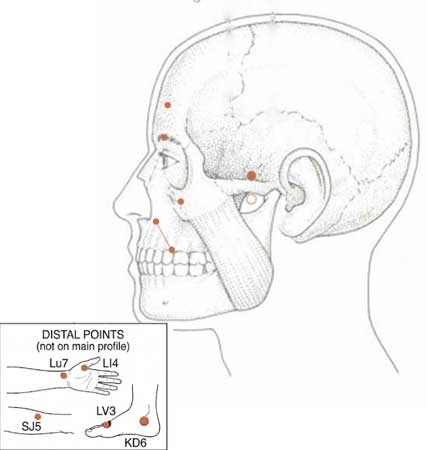
- Acupuncture points & technique — A wind-cold / Yangming channel prescription: DU-20, bilateral GB-20 and yuyao; on the affected left side GB-14, GB-1, taiyang, ST-4, ST-2, LU-7, and LI-20; on the right side LI-4, LI-11, SJ-5, LV-3, and KD-6. Electro-acupuncture with threaded 0.25 × 40 mm needles using shallow transverse insertion (e.g., ST-4 toward ST-2, SI-18 toward ST-7) at low intensity and low frequency, retained for 30 minutes.
- Adjunct therapies & home care — After needle removal, ~5 minutes of tuina along the bilateral facial channels and ~5 minutes of gua sha over the left side of the face. From the third session, low-level laser therapy (650 mW + 850 mW) was applied over each facial point for at least 60 seconds during the acupuncture. The patient was also given a gua sha tool for daily self-treatment at home.
- Frequency & duration — Initially one session per week; given the early response, increasing to two or three sessions per week was recommended, with treatment continuing on a regular weekly basis.
Outcome
The patient — a 51-year-old man whose left-sided facial paralysis began roughly ten days after a root canal — had not responded to four weeks of steroids in the acute phase and saw little change from irregular early acupuncture, leaving him essentially stalled for some 21–22 months after onset. His facial function was graded House-Brackmann V in the first weeks and House-Brackmann IV by the time structured treatment began.
Over the documented course of weekly sessions — combining electro-acupuncture, threaded transverse needling, tuina, and gua sha, with low-level laser therapy added from the third visit, he reported steady, progressive gains: the return of sensation in facial muscles he had not felt since onset, less frequent involuntary eye twitching, and improving ability to close the left eye and move the mouth, lips, and forehead, though still with some asymmetry. He was also given a gua sha tool for daily self-care at home.
By the most recent assessment, his facial function had improved to roughly House-Brackmann II–III. The case is notable because meaningful recovery was achieved in a chronic presentation treated nearly two years after onset, after conventional steroid therapy had failed.
Discussion
Synthesizing the allopathic, naturopathic, and TCM evidence suggests a two-phase approach. The first phase addresses the underlying cause: viral, bacterial, autoimmune, inflammatory, or structural. Proper diagnosis and early use of anti-inflammatory topicals, glucocorticoids, antibacterials, or antivirals may change the course of the outcome. The second phase focuses on restoring nerve function through acupuncture, hyperbaric oxygen to accelerate myelin and nerve regeneration, and B-vitamin and vitamin D support.
The recurring theme across all three traditions is that timing matters: steroids appear useful mainly within 24–72 hours of onset, and acupuncture response is strongest in earlier-stage presentations. A multimodal, early-initiated protocol offers the most promising path to recovering both motor and sensory function.
For educational purposes only; not medical advice.