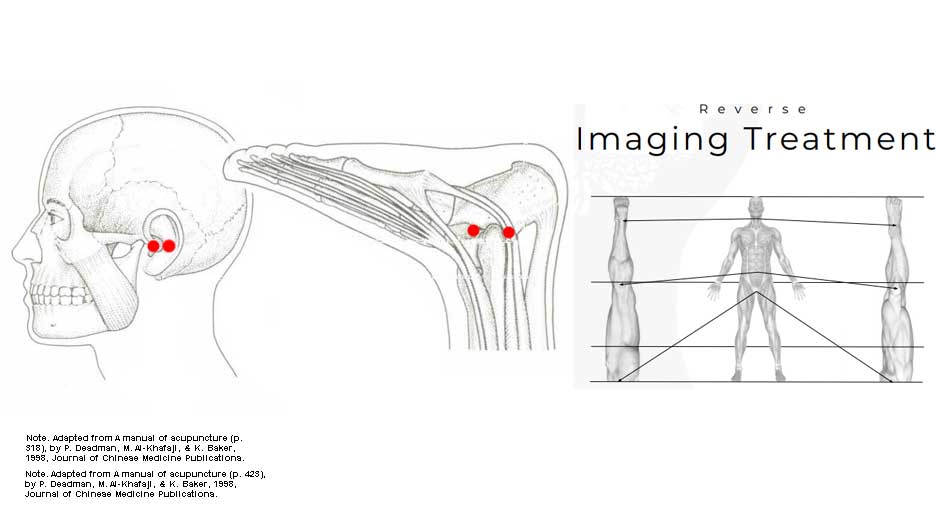
Patient presentation
A 65-year-old female presented with severe high-pitch tinnitus in the left ear. The patient rated the current tinnitus severity as 7/10 on a subjective scale but also reported that it gets worse night time, especially when she tries to sleep. She also reported that the right ear also but its tolerable and she rates as 2-3/10. The patient had been diagnosed with hypertension and atrial fibrillation, hypothyroidism,, GERD, depression, Meniere's disease and a history of breast cancer, heart surgery and pneumonia. The patient also diagnosed of by her medical doctor.
Treatment plan
The patient was positioned supine. Her right foot was elevated and supported with a soft bolster to facilitate needle access and patient comfort. This positioning allowed clear visualization of the lateral ankle anatomy and stable needle placement throughout the treatment session. Two ashi acupuncture points on the right foot were selected. The first point was located at the posterior-lateral corner of the right fibular malleolus, approximately 3mm from the bony prominence and slightly anterior to UB60 (Kunlun). A 30-gauge needle was inserted at this location to a depth of 3 cm. The needle was directed toward the talocalcaneal joint space. The second point was slightly posterior to GB40 (Qiuxu), located in the talar sinus anterior and inferior to the lateral malleolus. This point was needled using the same gauge needle deep into the tarsal sinus. The theoretical rationale for point selection was the reverse imaging principle mentioned in Dr. Richard Teh-Fu Tan's 1,2,3 Balance Method. The Balance method is a specific acupuncture approach derived from traditional knowledge principles, including Chinese meridian-name sharing, branching meridians, interior-exterior pairs, Chinese clock opposites, Chinese clock neighbors, and the same meridian. The method targets systemic channel balancing principles rather than local needling. This principle suggests balancing the sick meridians based on six systems that utilize imaging, mirroring, reverse imaging, and reverse mirroring. When the reverse imaging method is applied to this case, the left ear corresponds anatomically to the right lateral malleolus. Sick meridians KD and SJ of the left ear correspond anatomically to the GB and UB of the right lateral malleolus.Outcome
The patient experienced immediate symptom reduction following needle insertion. Tinnitus severity decreased from the initial rating of 7/10 to 3-4/10 within 30 seconds of needle placement. After 30 minutes of needle retention, the patient reported further improvement. Tinnitus severity was rated at 2/10 at this time point. The patient tolerated the needle retention period without difficulty. No adverse events occurred during the treatment session. Follow-up assessment was conducted over the phone on Day 7 post-treatment. The patient reported a tinnitus severity of 3-4/10, and she added that was not as annoying as it was before the treatment. This indicated partial maintenance of the initial treatment response. A second follow-up assessment was performed on Day 25. At this time point, the patient rated tinnitus severity at 4-5/10. The patient reported experiencing fluctuations in symptom intensity depending on the activities she does during the day but mostly intensifies when she goes to bed. The patient expressed intention to return for additional acupuncture treatment sessions.
Discussion
The rapid symptom reduction observed in this case, from 7/10 to 3-4/10 within 30 seconds of needle insertion, indicates a notable immediate response to distal contralateral needling of Ashi points based on Dr. Tan's balance method. This immediate effect does not align with patterns reported in research showing acupuncture efficacy for tinnitus. Furthermore, all systematic reviews have documented effects measured after multiple treatment sessions rather than within seconds [9][1][5]. The clinical significance of this case lies in demonstrating the potential of the Balance Method's distal contralateral needling approach for rapid symptom modulation. This technique differs fundamentally from conventional acupuncture protocols that predominantly use the Point-Energetics system or local needling with or without an electrical frequency stimulation device. The immediate response observed suggests potential for rapid symptom relief, though the partial return of symptoms indicates that single-session treatment may be insufficient for sustained benefit. This case presents a limited evidence base for the Balance Method application in tinnitus management. However, as a single case study without control conditions, it cannot establish causality or rule out placebo effects and spontaneous remission. Future research should use randomized controlled trial designs with validated outcome measures such as the Tinnitus Handicap Index, and extended follow-up periods [5][9].
References
[1] F. Liu, X. Han, Y. Li, and S. Yu, “Acupuncture in the treatment of tinnitus: a systematic review and meta-analysis,” European Archives of Oto-rhino-laryngology, vol. 273, no. 2, pp. 285–294, Feb. 2016, doi: 10.1007/S00405-014-3341-7.
[2] J. Park, A. White, and E. Ernst, “Efficacy of acupuncture as a treatment for tinnitus: a systematic review.,” Archives of Otolaryngology-head & Neck Surgery, vol. 126, no. 4, pp. 489–492, Apr. 2000, doi: 10.1001/ARCHOTOL.126.4.489.
[3] J. T. Chen and R. Jing, “The clinical efficacy of Scalp acupuncture for Tinnitus:A Systematic Review and Meta-Analysis,” Complementary Therapies in Medicine, vol. 88, pp. 103129–103129, Jan. 2025, doi: 10.1016/j.ctim.2025.103129.
[4] K. H. Lee, M. H. Kim, J.-H. Kim, and H. J. Nam, “Acupuncture for tinnitus: a scoping review of clinical studies,” Complementary Medicine Research, pp. 1–10, Mar. 2024, doi: 10.1159/000538236.
[5] E. J. Bousema, E. A. Koops, P. van Dijk, and P. U. Dijkstra, “Effects of Physical Interventions on Subjective Tinnitus, a Systematic Review and Meta-Analysis,” Brain Sciences, vol. 13, no. 2, pp. 226–226, Jan. 2023, doi: 10.3390/brainsci13020226.
[6] D. Brotto et al., “Auricular acupuncture for treating tinnitus: A systematic review,” Hearing, Balance and Communication, vol. 23, no. 2, pp. 43–51, Apr. 2025, doi: 10.4103/hbc.hbc_6_25.
[7] S. Yu, J. Wu, Y. Sun, and J. Lyu, “Advances in acupuncture treatment for tinnitus.,” American Journal of Otolaryngology, vol. 45, no. 3, pp. 104215–104215, Jan. 2024, doi: 10.1016/j.amjoto.2024.104215.
[8] B. Bataille and P. Mitariu, “Japanese Acupuncture: A Complementary Approach to the Meridian Balance Method.,” Medical Acupuncture, vol. 32, no. 4, pp. 194–200, Aug. 2020, doi: 10.1089/ACU.2020.1415.
[9] M. Wen-han, Z. Ding-qi, W. Zhao-jun, and M. Zhi-gang, “Meta Analysis on Domestic and Overseas Acupuncture Treatment for Nervous Tinnitus”, doi: 10.3969/j.issn.1005-5304.2014.02.006.
For educational purposes only; not medical advice. Patient consent obtained and identifying details removed.