Patient presentation
A 54 year old female with peanut allergy characterized by bilateral pruritic urticaria localized to inner thighs, pelvic, sacral, and perirectal regions. The patient reported that within 30 minutes to 4 hours following ingestion of peanuts or peanut-containing products, she would reliably develop intense itching and hives. Her symptoms usually dieappears in 3-5 days after stopping eating peanuts. The patient's medical history was otherwise unremarkable. She denies other food allergies, environmental allergies, asthma, eczema, or skin problems. She was not taking any regular medications and reported no chronic medical conditions.
Treatment plan
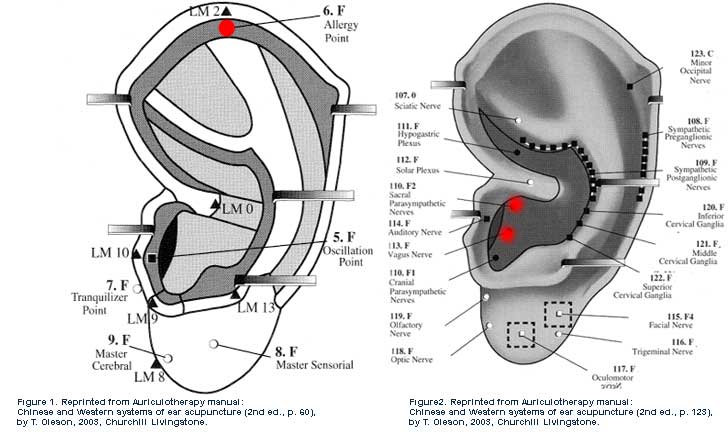
Three small, semi-permanent gold-covered ASP needles (Aiguille Semi-Permanente) were placed in the patient's left ear, following Nogier's auricular acupuncture map. These tiny needles are designed to stay in place for an extended period, providing gentle, continuous stimulation rather than the brief stimulation of a standard acupuncture session. The three points were selected for their roles in calming allergic and immune over-reactivity and in switching on the body's "rest-and-calm" (parasympathetic) nervous system.
The first needle was placed at point 6.F, the allergy point, located on the internal side of the apex of the ear the ridge of cartilage near the ear's center. This point is traditionally used for allergic conditions and for an over-active immune response. The second needle was placed at point 110.F, the sacral parasympathetic point, found in the inferior concha, superior and slightly lateral to the apex of the ear canal; on the auricular map, this area corresponds to the calming parasympathetic nerves that serve the pelvis and lower body. The third needle was placed at point 113.F, the vagus nerve point, located at the inferior concha, slightly lateral to the ear canal (the auricular branch of the vagus nerve innervates both superior and inferior concha and tragus) . This is considered a master point for activating the parasympathetic nervous system and for influencing the close interaction between the nerves and the immune system.
Outcome
With the needles in place, the patient ate spicy peanuts that same evening. By the following morning the hives and itching appeared on the right side of her inner thighs,pelvic, sacral, and perirectal regions but left side was calm and clear. She reported right side completely cleared after 4th day.
One week later , with the same semi-permanent needles still in her left ear, she repeated the peanut challenge. She experienced the exact same one-sided pattern: the left side remained clear, and only the right side broke out . Because this response was so consistent, the clinical plan was for her to return to the clinic to begin matching treatment on the right ear, with the goal of extending the calming effect to both sides of the body.
Discussion
The ear is anatomically unique: it is the only place on the body's surface that is reached by a branch of the vagus nerve, known as the auricular branch of the vagus nerve (ABVN). Placing needles in the ear can act like a gentle, ongoing form of vagus nerve stimulation. The vagus nerve is a key part of the body's autonomic nervous system. In this case, the semi-permanent needles in the left ear effectively stimulated the vagus nerve.
This case may indicate several clinical findings: 1-The most remarkable feature of this case is that the relief was strictly one-sided. Anatomical Specificity: The symptom suppression corresponded to the ipsilateral (left) side of the body. Although the typical allergic response is systemic because the circulatory system carries allergens throughout the entire body evenly, only the left side stayed clear of hives. 2-Reproducibility: The unilateral protective effect was observed consistently across two separate oral peanut challenges separated by one week, suggesting a genuine treatment effect rather than spontaneous variation in allergic response. 3-Sustained Effect: The protective effect persisted for at least 7 days with needles intact.
t is important to note that this case does not establish auricular acupuncture as a treatment for food allergy. The patient continued to experience allergic reactions. For anyone living with a food allergy, strict avoidance of the trigger food and a clinician-directed emergency plan remain essential.